
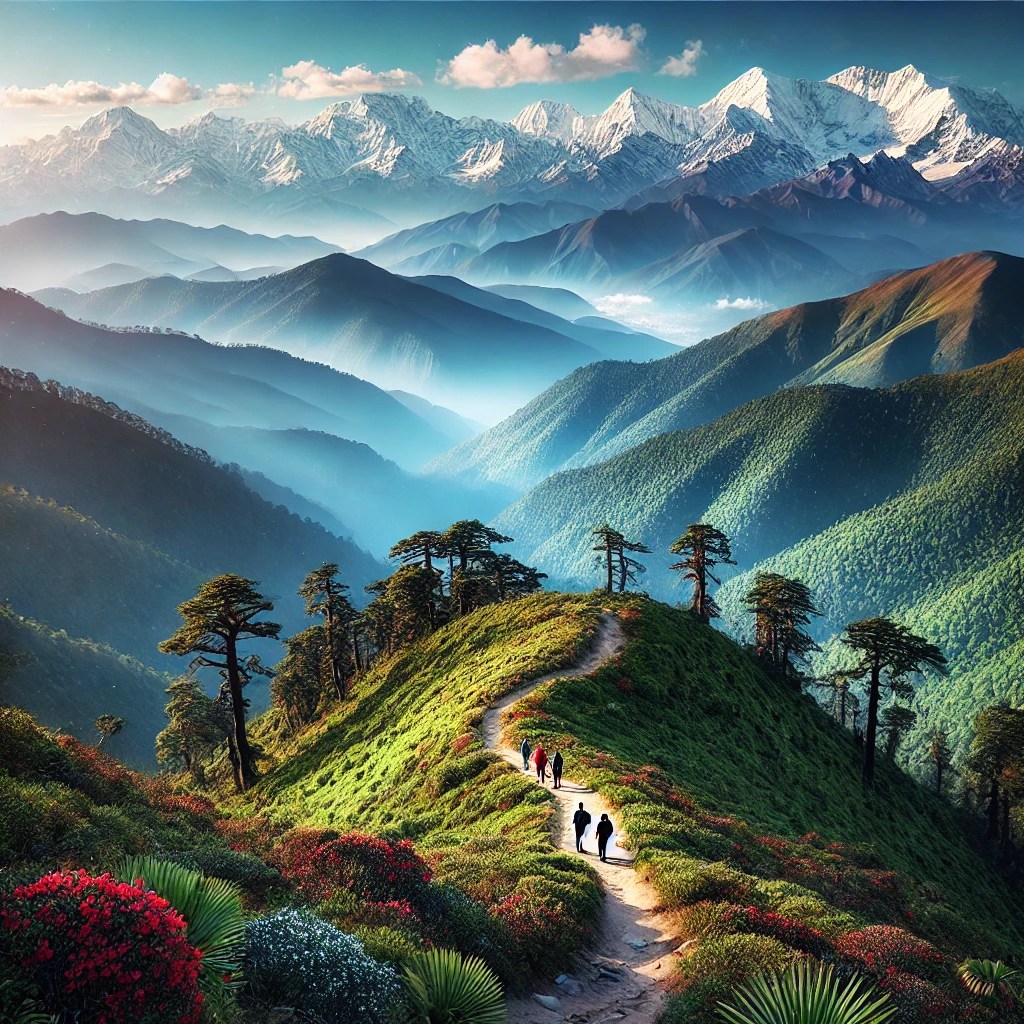
Here is an image of the Singalila Ridge Trek along the Indo-Nepal border, showcasing the breathtaking Himalayan landscape
The Singalila Ridge Trek is a captivating journey along the Indo-Nepal border, offering trekkers breathtaking vistas of the Himalayas, rich biodiversity, and a cultural tapestry woven from various local communities. Spanning the Singalila Ridge in the Eastern Himalayas, this trek is renowned for its panoramic views of some of the world’s highest peaks, including Mount Everest and Kanchenjunga.
Overview of the Singalila Ridge Trek
The trek primarily traverses through the Singalila National Park, situated in the Darjeeling district of West Bengal, India. Established as a national park in 1992, Singalila National Park covers an area of 78.6 square kilometers and ranges in elevation from 2,300 to 4,000 meters. The park is celebrated for its diverse flora and fauna, including the endangered red panda, and serves as a crucial habitat for numerous bird species, making it a paradise for birdwatchers.
Trekking Route and Highlights
The traditional route for the Singalila Ridge Trek begins at Manebhanjan, a quaint town approximately 28 kilometers from Darjeeling. The journey unfolds over several stages:
- Manebhanjan to Meghma (2,600 m): This initial leg is a four-hour ascent through verdant forests, passing through the village of Chitre.
- Meghma to Gairibans (2,621 m): Trekkers have two routes to choose from: one via Tonglu (3,070 m) and Tumling (2,900 m), and another that cuts through Nepal via Jaubari (2,750 m). Both paths offer mesmerizing views and a chance to experience the local culture.
- Gairibans to Sandakphu (3,636 m): This segment involves a steep climb, culminating at Sandakphu, the highest point in West Bengal. From here, trekkers are rewarded with panoramic views of the Himalayan giants, including Everest, Kanchenjunga, Lhotse, and Makalu.
- Sandakphu to Phalut (3,600 m): A 21-kilometer trek through pristine landscapes, this stretch offers unparalleled views of the Kanchenjunga and Everest ranges.
- Descent Options: Trekkers can retrace their steps to Manebhanjan or opt for a descent to the viage of Sirikhola via Gurdum (2,300 m), eventually reaching Rimbik.
Flora and Fauna
The Singalila National Park is a biodiversity hotspot. Trekkers can witness a variety of rhododendron species, magnolias, primulas, and orchids, especially during the spring season. The park’s forests are predominantly composed of Eastern Himalayan broadleaf trees and conifers. Wildlife enthusiasts might spot the elusive red panda, Himalayan black bear, leopard, and numerous bird species such as the blood pheasant and satyr tragopan.
Cultural Experience
The trek offers a rich cultural experience as it passes through various villages inhabited by communities like the Sherpas, Tamangs, and Rai. These communities have preserved their traditional lifestyles, and trekkers can experience their hospitality, traditional cuisines, and local customs.
Best Time to Trek
The ideal periods for the Singalila Ridge Trek are during spring (March to May) and post-monsoon (mid-September to early December). Spring showcases the region’s floral diversity in full bloom, while the post-monsoon season offers clear skies and unobstructed mountain views. The park remains closed to visitors from June 16 to September 15 due to the monsoon season.
Preparation and Permits
Trekkers are advised to prepare adequately for varying weather conditions and altitudes. Essential gear includes sturdy trekking boots, warm clothing, rain gear, and sleeping bags. Permits are required to enter the Singalila National Park and can be obtained at the entry point in Manebhanjan. Hiring a local guide is mandatory, both for safety and to support the local economy.
Accommodation
Along the trekking route, accommodation options range from trekkers’ huts and lodges to homestays in villages like Tumling, Kalapokhri, and Sandakphu. These establishments offer basic amenities and a chance to experience local hospitality.
Environmental Considerations
Trekkers are encouraged to practice responsible tourism by minimizing waste, avoiding plastic products, and respecting local customs and wildlife. The fragile ecosystem of the Himalayas requires conscious efforts to preserve its natural beauty for future generations.
Conclusion
The Singalila Ridge Trek is more than just a journey through the Himalayas; it’s an immersion into a world where nature’s grandeur meets rich cultural heritage. Whether you’re gazing at the towering peaks of Everest and Kanchenjunga, walking through forests teeming with life, or sharing stories with local villagers, this trek offers an experience that lingers long after the journey ends.
 Choose your right destination
Leave a comment